
Formulation and Process Optimization at a Daily Chemical Fragrance Manufacturing Plant
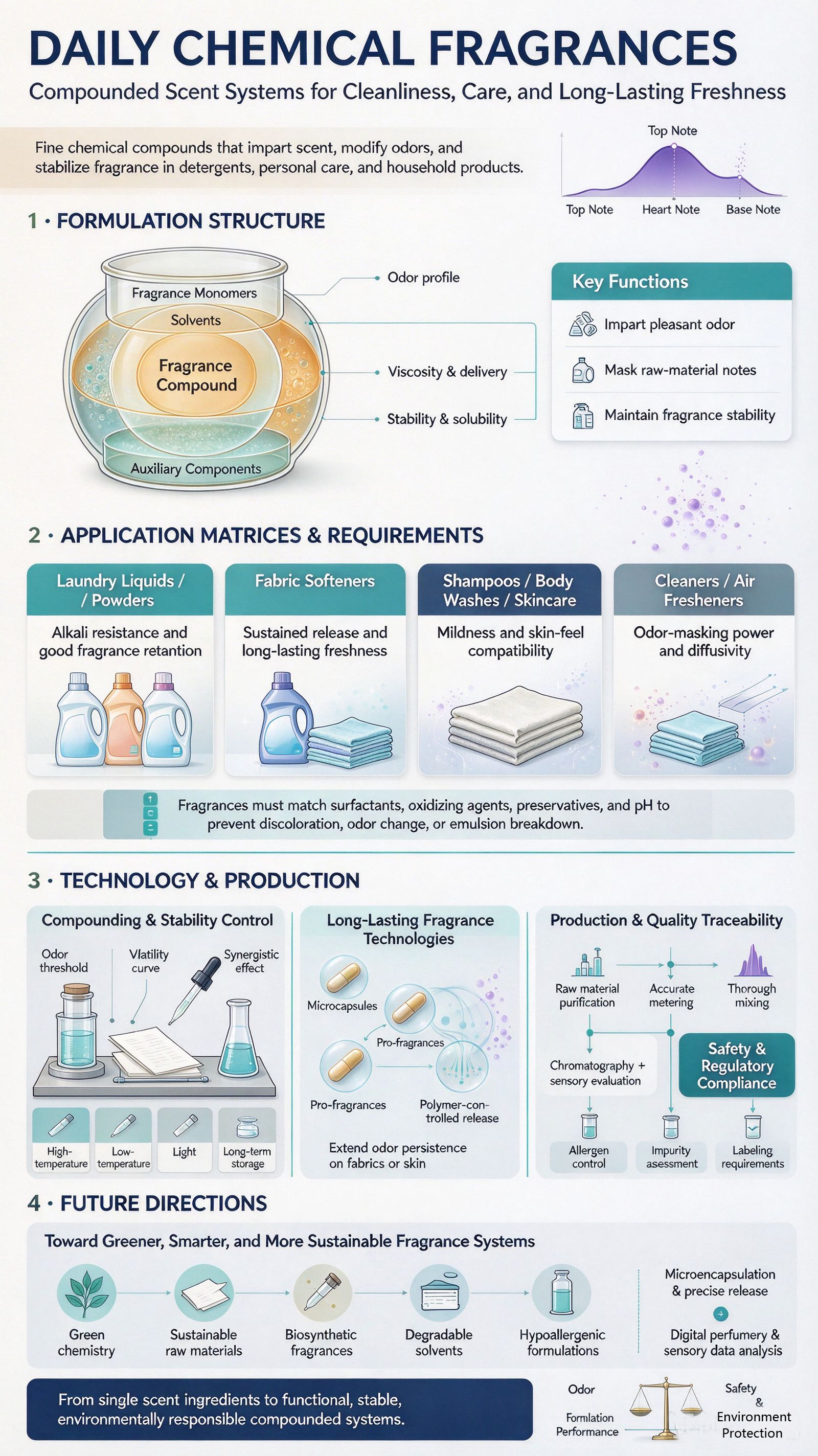
Daily chemical fragrances are fine chemical compounded products used to impart scent and modify odors in daily chemical products. They are usually composed of various fragrance monomers, solvents, and auxiliary components, and their odor profile is designed according to top, heart, and base notes. Their core function is to impart pleasant odors to detergents, personal care products, and household cleaners, mask undesirable odors from surfactants or raw materials, and maintain fragrance stability during storage and use. Compared with food flavors, daily chemical fragrances place greater emphasis on alkali resistance, heat resistance, light resistance, and compatibility with formulation systems.
In practical applications, daily chemical fragrances cover products such as laundry liquids, laundry powders, fabric softeners, shampoos, body washes, soaps, skin care products, cleaners, and air fresheners. Different substrates have clearly different requirements for fragrances: alkaline washing systems require good alkali resistance and fragrance retention; personal care products pay more attention to mildness and skin-feel compatibility; fabric care products value sustained release and long-lasting fragrance; and household cleaners emphasize odor-masking power and diffusivity. Fragrances must match surfactants, oxidizing agents, preservative systems, and pH conditions to avoid discoloration, odor change, or emulsion breakdown.
The technical characteristics are reflected in the combination of fragrance compounding and stability control. Perfumers combine fragrance materials based on odor thresholds, volatility curves, and synergistic effects so that the fragrance presents expected changes at different stages. At the same time, stability is evaluated through high-temperature, low-temperature, light, and long-term storage tests, and batch consistency is controlled by combining chromatography with sensory evaluation. Long-lasting fragrance technologies often use microcapsules, pro-fragrances, and polymer-based controlled release to improve odor persistence on fabrics or skin. Safety and regulatory compliance are also key links; allergenic components and impurities must be controlled to meet relevant safety assessment and labeling requirements.
The production stage emphasizes raw material purification, formula reproducibility, and quality traceability. The purity and odor characteristics of fragrance monomers affect the final fragrance. The compounding process requires accurate metering and thorough mixing, and batch quality is judged jointly by instrumental analysis and the perfumer's sensory evaluation. In terms of development prospects, green chemistry and sustainable raw materials are attracting attention. Natural extracts and synthetic fragrances will coexist for a long time, and biosynthetic fragrances, degradable solvents, and hypoallergenic formulations have become technical directions. Microencapsulation and precise release technologies are expected to improve fragrance retention efficiency, while digital perfumery and sensory data analysis can also assist formulation optimization.
In the future, the development of daily chemical fragrances needs to strike a balance among odor performance, formulation stability, safety and environmental protection, and raw material sustainability. As daily chemical product systems become increasingly complex, fragrance companies need to strengthen substrate compatibility research, controlled-release technology development, and life-cycle environmental impact assessment, while maintaining the differentiation and manufacturability of fragrance design. Overall, daily chemical fragrances will evolve from single odor-imparting materials into fine chemical compounded systems that also take into account functionality, stability, and environmental protection.

